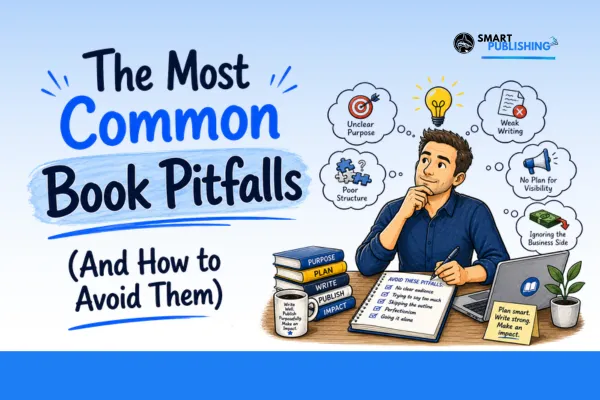
The Most Common Book Pitfalls (And How to Avoid Them)
The Most Common Book Pitfalls (And How to Avoid Them)
Smart Publishing Impact Series – Episode 64
Publishing a book has never been easier. Publishing a successful book, however, remains just as challenging as ever.
Every year, thousands of authors release books with high hopes. Many invest months—or even years—into writing their manuscript. Yet after launch, they find themselves disappointed. Sales are underwhelming. Speaking opportunities never materialize. Leads do not come in. The book fails to create the authority, credibility, or business growth they envisioned.
At Smart Publishing, we frequently work with authors who come to us after experiencing this exact situation. They have already published a book, but something did not work. They want an objective assessment of what went wrong and whether the book can be repositioned or relaunched more effectively.
While every situation is unique, the same mistakes appear repeatedly. Some issues originate in the book itself, while others stem from poor launch strategy or a lack of long-term planning. Understanding these pitfalls before publishing can dramatically improve your chances of success.
Pitfall #1: Choosing the Wrong Title and Subtitle
The first mistake often occurs before readers ever open the book.
A book's title serves as its first impression. If the title is generic, difficult to remember, or nearly identical to an existing bestselling book, it becomes much harder to stand out in a crowded marketplace. Readers need something distinctive that captures attention and creates curiosity.
The subtitle is equally important. Unfortunately, many authors treat the subtitle as an opportunity to sound clever rather than communicate clearly.
The purpose of a subtitle is straightforward: it should explain what the book is about and who it is for.
A reader who encounters your book for the first time should immediately understand its subject matter and value proposition. Clarity consistently outperforms cleverness when it comes to book marketing. Readers do not reward ambiguity. They reward understanding.
Strong titles create interest. Strong subtitles create understanding. Together, they create momentum.
Pitfall #2: An Amateur-Looking Cover
The old saying tells us not to judge a book by its cover.
Readers do it anyway.
Book covers function as marketing assets, not simply design elements. A professionally designed cover signals credibility, quality, and expertise. An amateur cover creates doubt.
One of the most common mistakes authors make is attempting to design their own cover using tools like Canva. While these platforms are useful for many marketing applications, professional book cover design requires specialized knowledge of typography, visual hierarchy, genre expectations, and buyer psychology.
Readers make decisions in seconds. If the cover does not communicate professionalism immediately, many potential buyers will never investigate further.
A great book deserves a great presentation.
Pitfall #3: A Weak Book Description
Once readers click on your book, the description becomes the next critical decision point.
Unfortunately, many book descriptions fail to answer the questions readers are actually asking.
Instead of clearly communicating the value of the book, authors often begin with vague, poetic, or AI-generated language that sounds impressive but says very little. These opening lines frequently create confusion rather than interest.
The strongest book descriptions begin by addressing the reader directly. They quickly establish who the book is for, what problem it solves, and what outcomes the reader can expect.
A high-converting description typically includes:
A strong opening hook
Clear audience identification
A concise overview of the book's purpose
A list of key takeaways or benefits
A compelling reason to take action
Book descriptions are sales copy. Their purpose is to help readers understand why the book matters to them.
Pitfall #4: Missing Amazon A+ Content
Many authors overlook one of Amazon's most valuable marketing features: A+ Content.
A+ Content allows authors to add enhanced visual sections below their product description, including graphics, expanded messaging, comparison charts, testimonials, and additional branding elements.
These sections create a more polished presentation and help reinforce the value of the book.
Readers increasingly expect a professional online buying experience. A+ Content provides another opportunity to communicate authority, credibility, and quality before the purchase decision is made.
When used effectively, it can significantly improve conversion rates.
Pitfall #5: Limiting Book Formats
Some authors publish only a paperback version.
Others publish only a Kindle version.
Both approaches leave opportunities on the table.
Readers consume books in different ways. Some prefer physical books they can hold and highlight. Others primarily read digitally. Still others prefer hardcover editions because they perceive them as premium products.
Offering multiple formats expands your potential audience and increases the flexibility of your marketing strategy.
At a minimum, authors should strongly consider publishing both Kindle and paperback editions. Hardcover editions can add additional perceived value, particularly when books are used as business development tools, gifts, or premium authority-building assets.
The easier you make it for readers to consume your content, the larger your potential audience becomes.
Pitfall #6: Poor Editing and Formatting
Even strong ideas can be undermined by poor execution.
Nothing damages credibility faster than a book filled with grammatical errors, formatting inconsistencies, awkward phrasing, or confusing structure.
Professional editing serves a much larger purpose than correcting spelling mistakes. Experienced editors help authors improve clarity, strengthen arguments, eliminate redundancy, and identify blind spots that the author may not see.
Similarly, professional formatting creates a reading experience that feels polished and trustworthy.
Readers may not consciously notice excellent formatting. They absolutely notice poor formatting.
Authors often underestimate how much presentation influences perception. A professionally edited and formatted book signals professionalism. A poorly executed book creates doubt about the author's expertise.
Pitfall #7: Launching on the Wrong Day
Timing matters more than many authors realize.
A common mistake is selecting a launch date based on personal convenience rather than reader behavior.
Through numerous launches, we have consistently found that Tuesdays often perform exceptionally well. Mondays tend to be chaotic as people settle into the workweek. By Thursday and Friday, attention begins shifting toward the weekend. Saturday and Sunday introduce additional distractions.
A well-timed launch can generate greater momentum during those crucial first days when bestseller rankings and visibility matter most.
While launch timing is only one variable, it remains an important piece of the overall strategy.
Pitfall #8: Insufficient Launch Preparation
Many authors begin marketing only after the book is available.
By that point, they are already behind.
Successful launches are built weeks or months before publication. Authors should spend time developing an audience, creating anticipation, and identifying supporters who are willing to purchase and promote the book during launch week.
Effective pre-launch activities may include:
Building an email list
Creating a launch team
Appearing on podcasts
Developing influencer relationships
Sharing behind-the-scenes content
Collecting endorsements and testimonials
Momentum rarely appears by accident. It is usually the result of intentional preparation.
Pitfall #9: Poor Pricing Strategy
Pricing plays a significant role in launch performance.
Many first-time authors price their Kindle edition too high during launch week, creating unnecessary resistance for potential buyers.
For launch purposes, lower pricing often encourages more purchases, which can help increase ranking velocity and visibility.
This does not mean undervaluing your work long-term. It simply means recognizing that launch week has different objectives than ongoing sales.
A strategic launch price can help maximize exposure during the period when visibility matters most.
Pitfall #10: No Long-Term Strategy
This is perhaps the most important mistake of all.
Many authors believe publishing the book is the finish line.
In reality, publication is the starting point.
Books create opportunities when authors actively use them as tools. The most successful authors understand exactly what role their book will play within their broader business, professional, or personal goals.
Before writing even begins, authors should ask:
Do I want speaking opportunities?
Do I want consulting clients?
Do I want leads for my business?
Do I want greater authority in my industry?
Do I want to build a personal brand?
Once those objectives are clear, the book can be strategically designed to support them.
Without a long-term plan, even a well-written book may struggle to create meaningful results.
Final Thoughts
The difference between a book that quietly disappears and a book that creates lasting opportunities often has very little to do with the quality of the author's ideas.
More often, the difference lies in strategy.
Successful books are built intentionally. They combine strong positioning, professional presentation, thoughtful marketing, and a clear understanding of the outcomes the author wants to achieve.
Publishing a book remains one of the most powerful authority-building tools available today. However, simply releasing a book is not enough.
Authors who approach publishing strategically place themselves in a much stronger position to create influence, generate opportunities, and make a lasting impact.
Because at the end of the day, the goal is not simply to publish a book.
The goal is to publish a book that works.
Until next time—
Keep writing your story, because the world needs your voice.
—Renée

