How to Choose the Right Publishing Path for Your Book
How to Choose the Right Publishing Path for Your Book
Smart Publishing Impact Series – Episode 71
Every aspiring author eventually asks the same question: Should I self-publish, work with a publisher, or pursue a traditional publishing deal?
It is a practical question, but it is not the first one that should be answered.
The publishing path that makes the most sense depends far less on the manuscript itself than on what you hope the book will accomplish after it is finished. A memoir intended for family members has very different goals from a business book designed to attract clients. Likewise, a children's book written as a keepsake follows a different trajectory than one intended for bookstores, libraries, and classrooms.
Choosing a publishing strategy becomes much easier when you begin by defining the role you want your book to play. During Episode 71 of the Smart Publishing Impact Series, this idea became the foundation for a broader conversation between Jonathan and I about how authors can make publishing decisions that support their long-term goals rather than simply getting a book into print.
Start With the Purpose Behind the Book
Every publishing decision becomes clearer once you understand why you are writing the book.
For some authors, completing the manuscript fulfills a deeply personal goal. The writing process itself provides satisfaction because it preserves memories, documents experiences, or captures ideas that have been waiting to take shape. These projects often become treasured family keepsakes or creative accomplishments that hold lasting personal significance.
Other books are written with a broader audience in mind. Authors may hope to educate readers, establish authority within their profession, strengthen a ministry, support a business, or create opportunities for speaking and consulting. In these cases, the finished book serves a larger purpose that extends well beyond publication.
Neither objective is more valuable than the other. Each simply leads toward a different publishing strategy, and recognizing that distinction early helps authors make thoughtful decisions throughout the publishing process.
Think Beyond Finishing the Manuscript
Many first-time authors devote nearly all of their attention to writing the book itself.
While completing a manuscript is a significant accomplishment, publication marks the beginning of another stage rather than the end of the journey. Once the book is available, readers still need a way to discover it.
That raises a new set of questions.
Will you speak about your book?
Will you appear on podcasts?
Will you connect with organizations that serve your audience?
Will you build relationships within your industry or community?
These questions are worth considering before publication because they shape the role your book will play after launch. Authors who enjoy networking, speaking, teaching, or building communities often approach publishing differently from those whose goals remain more personal or localized.
Match the Publishing Model to Your Goals
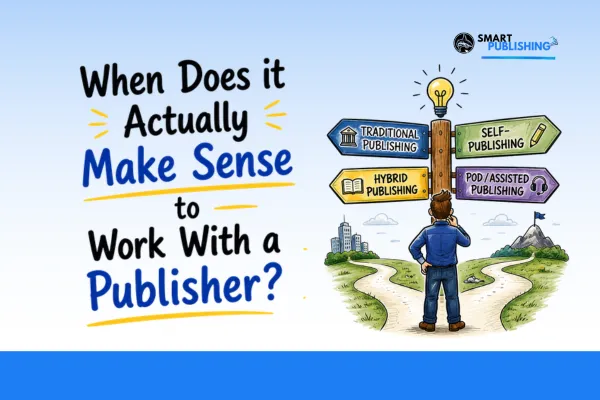
Every publishing option offers a different combination of responsibility, support, flexibility, and creative control.
Self-publishing appeals to many authors because it allows complete ownership of every decision. Writers who enjoy managing projects independently or who are creating books primarily for personal fulfillment often appreciate the freedom this approach provides.
Traditional publishing offers access to established publishing infrastructure and wider commercial distribution, although authors typically work within the publisher's editorial and business processes.
Professional independent publishing provides another alternative by combining professional editing, design, production, and strategic guidance while allowing authors to remain actively involved in shaping the finished book.
The most appropriate choice depends upon your goals rather than the popularity of any particular publishing model.
Consider What Happens After Someone Reads Your Book
Many successful nonfiction books continue creating opportunities long after readers finish the final chapter.
Business owners frequently use books to introduce prospective clients to their philosophy, methodology, and expertise. Consultants and coaches often find that a book answers foundational questions before the first meeting ever takes place. Readers gain confidence by seeing how the author approaches challenges, communicates ideas, and delivers value.
This allows the book to become a natural extension of the author's broader professional mission. Rather than functioning as an isolated product, it contributes to building trust and creating meaningful relationships with future clients, partners, or collaborators.
Authors who understand this possibility often make different decisions about editing, production quality, and long-term marketing because they recognize that the book may introduce them long before they introduce themselves.
Every Book Reflects Its Author
Readers form impressions quickly.
The quality of the editing, cover design, typography, formatting, and overall presentation all contribute to how readers experience a book. These details communicate the level of care invested in the project, and they naturally influence how readers perceive the author behind it.
This becomes especially important when a book supports a business, professional practice, or ministry. A polished publication reinforces credibility because it reflects the same attention to detail that readers hope to encounter throughout the author's work.
Investing in professional production is ultimately an investment in the reader's experience. Strong editing improves clarity, thoughtful design enhances readability, and cohesive presentation allows the message to remain the focus of the book.
Build Around the Audience You Want to Serve
One of the most valuable shifts an aspiring author can make is moving beyond the goal of simply becoming a published author.
Publishing is an important milestone, but the lasting impact of a book depends upon the readers it reaches and the conversations it begins. Authors who think carefully about their audience before publication are better prepared to choose marketing strategies, partnerships, and publishing models that support those readers effectively.
This perspective also encourages authors to view the book as part of a larger body of work. Whether that includes additional books, workshops, speaking engagements, educational programs, or professional services, the manuscript often becomes the foundation upon which many future opportunities are built.
Final Thoughts
Choosing a publishing path begins with understanding what success looks like for your book.
Some authors hope to preserve a meaningful story for future generations. Others want to educate, inspire, or build authority within a particular field. Many seek to create opportunities that extend well beyond the pages of the book itself.
Each of those goals deserves a publishing strategy designed to support it.
When authors take time to clarify their purpose before making publishing decisions, they position themselves to create a book that not only reflects their message but also supports the future they hope that message will help create.
Until next time—
Keep writing your story, because the world needs your voice.
—Renée

