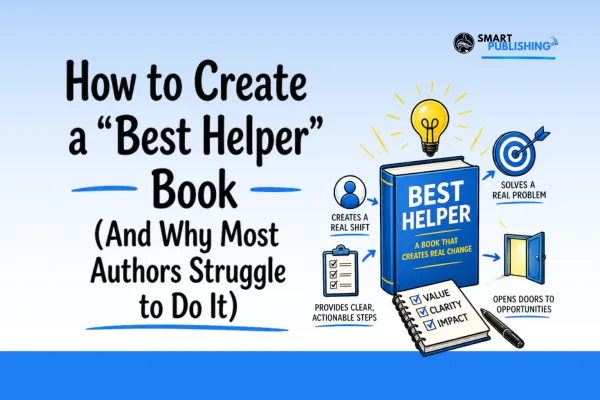
How to Create a “Best Helper” Book (And Why Most Authors Struggle to Do It)
How to Create a “Best Helper” Book (And Why Most Authors Struggle to Do It)
📘 Smart Publishing Impact Series – Episode 59 (Part 2)
In the previous article, we introduced a concept that fundamentally changes how authors should think about success:
Bestsellers get attention—but best helpers create results.
That idea is simple, but its implications are significant. It reframes the purpose of writing a book entirely. Instead of focusing on rankings, recognition, or even sales alone, it shifts the author’s attention toward something more meaningful: creating a book that produces real outcomes—for the reader and for the author.
However, understanding why this matters is only the first step. The more practical—and often more difficult—question is what comes next:
How do you actually write a book that helps?
This is where many authors encounter friction. Not because they lack ideas, and not because they are incapable of writing, but because they attempt to solve a structural problem with effort alone. They begin writing before they have defined what the book is meant to do, and as a result, the process becomes unnecessarily complex.
To move forward effectively, it is necessary to revisit the foundation established in Part 1 and build on it with greater precision.
The Transition from Concept to Execution
In Part 1, we established that a book’s value is not determined solely by its visibility, but by its ability to create movement. A best helper is defined by its capacity to guide the reader from their current state to a more desirable one. It is, by design, functional.
The transition from concept to execution, however, requires a different level of clarity. It requires the author to move from abstract intention to concrete decisions.
At this stage, the process becomes less about what you want to say and more about what the reader needs to do.
This distinction is critical.
When authors remain focused on expression, the writing tends to expand without direction. When they shift toward application, the content becomes structured, purposeful, and far more effective.
The Clarity Gap That Disrupts the Writing Process
Most authors underestimate the level of specificity required to create a functional book. They begin with a general idea—often rooted in personal experience or professional knowledge—but do not refine that idea into a clearly defined problem-solution relationship.
As a result, the writing process becomes fragmented. Chapters begin to overlap. Key ideas are introduced without sufficient development. Stories are included without a clear connection to the reader’s situation.
This is not a reflection of the author’s capability. It is the natural outcome of writing without a defined framework.
To avoid this, the author must answer two questions—not broadly, but with operational clarity:
Who is the reader, specifically, and what problem are they actively trying to solve?
What is the intended outcome of this book for the author, beyond publication?
These questions were introduced previously, but here they take on a more practical role. They are no longer conceptual—they are structural.
Without clear answers, the book lacks direction. With them, every decision becomes easier.
Why Most Authors Default to Story—and Why It Creates Problems
When authors begin writing without a defined structure, they often default to the most accessible material: their own story.
This is understandable. Personal experience feels authentic and readily available. It provides a starting point when the structure is unclear.
However, stories—while valuable—are inherently expansive. They contain multiple elements: context, emotion, detail, and progression. Without a guiding principle, it becomes difficult to determine which aspects of the story are relevant and which are not.
This leads to several common issues:
The narrative becomes inconsistent in focus
Important ideas are diluted within excessive detail
The reader struggles to extract clear meaning or direction
The book may still be engaging, but it fails to function as a tool for change.
Reversing the Order: From Narrative to Principle
A more effective approach is to reverse the sequence.
Instead of beginning with story, the author begins with principle.
A principle is a clearly defined concept—something that can be stated concisely and applied broadly. It serves as the foundation of the chapter, providing direction and constraint.
Once the principle is established, the story is introduced as a supporting element. It is selected not because it is interesting, but because it illustrates the principle in a way that is accessible and relevant to the reader.
This shift produces a more disciplined structure:
The principle defines what the reader needs to understand
The story demonstrates how that principle appears in practice
The application translates the idea into action
Each element has a defined role, and together they create a cohesive experience.
The Missing Component: Application
Even when authors successfully combine principle and narrative, many books still fall short of producing results. The reason is consistent: they stop at insight.
Insight creates awareness, but it does not create change.
For a book to function as a best helper, it must extend beyond explanation and into application. It must guide the reader toward a specific action or shift in behavior.
This requires the author to address, explicitly, how the principle applies to the reader’s context.
Effective application does not require complexity, but it does require clarity. It can take several forms:
A structured framework that outlines a process
A scenario that mirrors the reader’s situation
A set of actionable steps that can be implemented immediately
The objective is to eliminate ambiguity. When a reader finishes a chapter, they should not be left interpreting what to do next. The path forward should be evident.
The Role of Instructional Narrative
It is important to recognize that this approach does not diminish the importance of storytelling. Rather, it refines its purpose.
In a purely narrative work, the story itself is the outcome. In a best helper, the story is a vehicle for instruction.
This distinction gives rise to what is often referred to as an instructional memoir—a format that combines personal experience with practical guidance. In this model, the author’s life becomes a source of case studies, and each story is examined for its underlying lesson.
The value of the story, then, is not in the event itself, but in what it teaches.
Why Structure Accelerates, Rather Than Restricts, the Process
A common concern among authors is that structure will limit creativity. In practice, the opposite is true.
Structure reduces uncertainty.
When the author has defined:
The audience
The problem
The principle of each chapter
The intended outcome
The writing process becomes a matter of execution rather than exploration.
This is why some authors experience prolonged difficulty completing a manuscript, while others are able to produce a complete and effective book within a focused timeframe. The difference lies not in effort, but in clarity of direction.
Connecting Back to the Core Idea
The distinction introduced in Part 1—between attention and outcomes—remains central to this discussion.
A book that is written without structure may still attract attention. It may even achieve short-term success. But without clear principles and actionable guidance, it is unlikely to produce sustained results.
A best helper, by contrast, is designed to function. It is built with intention, structured around principles, and completed with application.
It does not rely on visibility alone. It creates value that extends beyond the page.
Final Thoughts
Writing a book is a meaningful endeavor, but its effectiveness is determined long before it is published.
A book that is created without clarity may still be completed, but it will struggle to produce results. A book that is structured intentionally—from audience to principle to application
—becomes something more than content.
It becomes a tool.
And when a book functions as a tool, it creates movement—for the reader, and for the author.
Until next time—
Keep writing your story, because the world needs your voice.
—Renée

