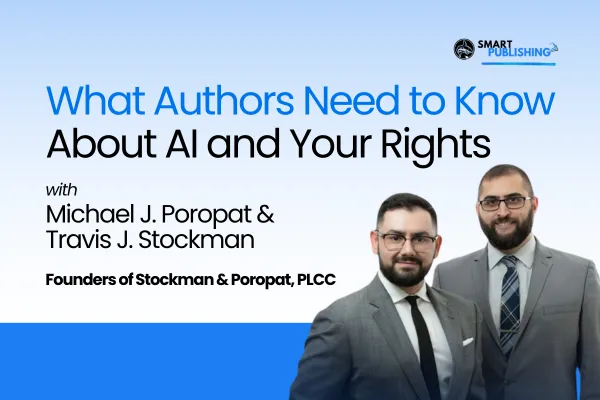
Amazon’s “Ask This Book” Feature: What Authors Need to Know About AI and Your Rights
Amazon’s “Ask This Book” Feature: What Authors Need to Know About AI and Your Rights
📘 Smart Publishing Impact Series – Episode 54
AI is moving fast.
And with every new feature, authors are being pulled into questions they never thought they’d have to ask:
Who owns my work?
Can my content be used without permission?
And what happens when AI starts interpreting my book… without me?
In this episode, we brought in two intellectual property attorneys to unpack one of the most controversial developments right now:
Amazon Kindle’s “Ask This Book” feature.
And what it means for you as an author.
What Is “Ask This Book”?
Amazon has started rolling out a feature inside Kindle where readers can:
Ask questions about your book
And receive AI-generated answers instantly
Think of it like ChatGPT… but trained on your book.
At first glance, it sounds helpful.
But here’s where things get complicated.
The Core Issue: You Don’t Control It
This feature is not something authors opt into.
You don’t:
Approve it
Edit it
Review it
Or even get notified when it’s applied
It can simply appear on your book.
And that creates a major shift:
Your content is now being interpreted by AI
Without your input
And presented as if it reflects your work
That’s where the controversy begins.
The Biggest Concerns for Authors
1. AI Can Misrepresent Your Message
A reader can ask a question about your book…
And the AI will generate an answer.
But here’s the problem:
That answer may not reflect your true intent
It may simplify, distort, or reinterpret your ideas
And you have no ability to correct it.
For authors—especially those building authority—this is a serious risk.
2. It May Replace the Reading Experience
Let’s be honest:
People already look for shortcuts.
Now instead of reading your book, someone can:
Ask for summaries
Pull key ideas
Skip the full experience
That means:
Less engagement
Less connection
And potentially less perceived value
Your book becomes a reference tool, not a transformation.
3. The Legal Line Is Blurry
This is where things get even more interesting.
There are two competing perspectives:
Amazon’s stance: This is just an extension of search
Authors’ concern: This may be a derivative work
A derivative work means:
Something new is created based on your original content
If AI is:
Interpreting
Summarizing
Or generating new explanations
Then the question becomes:
Is it still your work—or something new built from it?
And right now…
There’s no clear legal answer yet.
The Bigger Picture: AI and Copyright
This feature is just one example of a much larger shift.
We’re entering a world where:
AI can read your content
Learn from it
And generate new outputs from it
But here’s the key takeaway from the legal perspective:
AI doesn’t remove your responsibility—it increases it.
If You Use AI to Create Content…
This is where many authors get it wrong.
Using AI might feel like the shortcut.
But legally and strategically, it introduces risk.
Risk #1: You Might Be Infringing Without Knowing
AI pulls from existing data.
So even if it generates something “new”:
It may still be based on existing copyrighted material
And you are responsible for that—not the AI.
Risk #2: You May Not Own What You Create
Here’s the big one: Copyright law currently requires human authorship
So if AI creates your content:
You may not fully own it
You may not be able to protect it
You may not be able to enforce it
That means:
No real control. No real protection. And no real long-term asset
The Difference: AI-Assisted vs AI-Generated
This is the line that matters.
AI-Assisted
You create the core content
AI helps refine, edit, or enhance
✅ You retain ownership
✅ You maintain originality
AI-Generated
AI creates the content
You simply prompt it
⚠️ Ownership becomes unclear
⚠️ Protection becomes weak
What Smart Authors Should Do Instead
If your goal is to build authority (not just publish a book):
Use AI as a tool—not a replacement
Here’s the smarter approach:
Use AI for outlining
Use AI for light editing
Use AI for brainstorming
But: Your ideas. Your voice. Your stories.
Must come from you.
Because that’s what makes your book valuable.
Can AI Books Be Banned in the Future?
Short answer:
Probably not.
But what’s more likely:
Platforms may require disclosure
Readers will become better at spotting AI
Trust will shift toward human-created work
Which leads to a simple truth:
Human content will become more valuable—not less.
How to Protect Yourself Moving Forward
You don’t need to overhaul everything.
But you do need to be intentional.
Focus on:
Creating original content
Documenting your authorship
Registering your work properly
And most importantly: Build something worth protecting
Because protection only matters if the asset itself is strong.
Final Thoughts
AI is not going away.
But neither is authorship.
The authors who win in this next era will not be the ones who rely on AI to create for them…
They’ll be the ones who:
Use AI strategically
Stay rooted in originality
And protect what they build
Because at the end of the day—
Your voice is still your greatest asset.
Until next time—
Keep writing your story, because the world needs your voice.
—Renee

