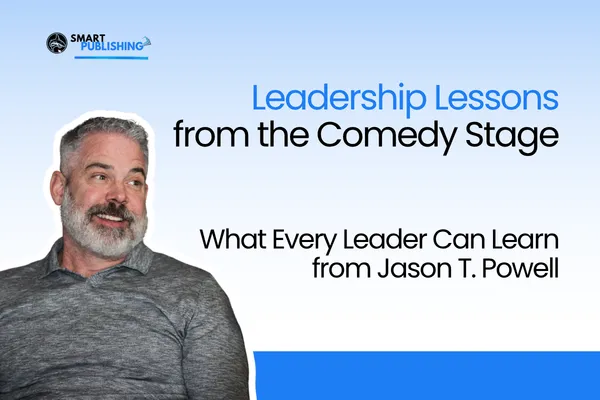
Leadership Lessons from the Comedy Stage: What Every Leader Can Learn from Jason T. Powell
Leadership Lessons from the Comedy Stage: What Every Leader Can Learn from Jason T. Powell
Smart Publishing Impact Series – Episode 68
Leadership is often taught through business case studies, management theories, and organizational frameworks. While those resources have their place, some of the most valuable leadership lessons are learned in environments where success depends entirely on earning trust, reading people, and adapting in real time.
Stand-up comedy is one of those environments.
Every performance is an exercise in leadership. A comedian walks onto a stage in front of complete strangers with one objective: create enough trust that an audience willingly follows wherever the story leads. There are no guaranteed outcomes. Every room is different. Every audience reacts differently. Success depends on observation, communication, authenticity, and the ability to recover quickly when things go wrong.
In Episode 68 of the Smart Publishing Impact Series, Jason T. Powell discusses his forthcoming book, Laughs to Leadership, and explains how decades of experience as a comedian, coach, speaker, and leader shaped the leadership principles he now teaches. While his stories often generate laughter, the lessons behind them apply to anyone responsible for leading people, whether in business, education, ministry, or family life.
Leadership Exists Wherever People Choose to Follow
One of the most important themes throughout the conversation was that leadership extends far beyond traditional management roles.
Jason has spent his career coaching elite gymnasts, speaking on stages, leading sales teams, performing comedy, and raising two children. Although each environment looks different, he eventually recognized that the same leadership skills applied across all of them. The techniques that helped him coach athletes also helped him become a better father. The communication skills developed through comedy strengthened his effectiveness as a speaker and trainer. Leadership was never confined to the workplace because people choose to follow in every area of life.
Many people mistakenly assume leadership begins with a title or promotion. In reality, leadership begins whenever someone influences another person's actions, thinking, or direction.
Parents lead children.
Teachers lead students.
Business owners lead teams.
Coaches lead athletes.
Even individuals working independently practice self-leadership through the decisions they make every day.
Understanding this broader definition helps explain why leadership skills are valuable regardless of profession.
Comedy Creates Exceptional Leaders
At first glance, stand-up comedy and leadership appear unrelated.
Jason argues the opposite.
Every comedian must quickly assess an audience, establish credibility, maintain attention, adapt to changing circumstances, recover from mistakes, and communicate ideas in ways that resonate emotionally. Those same abilities directly influence leadership effectiveness.
Successful comedians constantly observe the room before deciding how to proceed. They recognize when energy changes. They adjust pacing, tone, and delivery accordingly. They understand that communication depends as much on listening and observation as speaking.
Leaders face remarkably similar challenges.
Every meeting, presentation, coaching conversation, or difficult discussion requires reading the room before attempting to move people toward a desired outcome. Technical knowledge alone rarely creates engagement. Connection comes first. Trust creates the opportunity for influence.
Throughout the interview, Jason explained that many of the leadership systems described in his book originated through years of learning these lessons under the unique pressure of live audiences.
Growth Often Begins With Embarrassing Moments
One of the most memorable stories discussed during the episode occurred long before Jason ever became a comedian.
As a young child, he experienced what many people would consider one of the most embarrassing moments imaginable while performing on stage. Rather than ending his willingness to speak publicly, that experience eventually became one of the defining moments that shaped his confidence. Looking back, Jason realized that surviving an experience he once believed would define him actually removed much of the fear surrounding future public speaking opportunities.
He shared another example from his comedy career involving one of the worst performances he had ever given. After bombing on stage, a veteran comedian reassured him that he had already experienced the worst-case scenario. Once that fear disappeared, his performances improved dramatically because he was no longer performing from a place of anxiety.
These stories highlight an important leadership principle.
Confidence rarely develops because someone avoids failure.
Confidence develops because someone survives failure and discovers they are still capable of moving forward.
Leaders who embrace difficult experiences often gain resilience that cannot be developed through success alone.
Authenticity Builds Trust
Jonathan observed that one of Jason's greatest strengths as an author is his willingness to include stories that do not always portray himself as the hero.
Many people naturally want to present only their successes. Jason intentionally chose a different approach.
Throughout Laughs to Leadership, he shares mistakes, setbacks, awkward moments, and difficult experiences because those stories create genuine connection with readers. Rather than positioning himself as someone who has mastered every situation, he presents himself as someone who has learned through experience and continues growing.
Readers often connect more deeply with authors who communicate honestly than with those who present polished perfection.
Authenticity builds credibility because it allows readers to recognize their own experiences within the author's journey.
This principle extends directly into leadership.
People are more likely to trust leaders who demonstrate humility, honesty, and self-awareness than those who attempt to project flawless confidence at all times.
Leadership Is About Helping People Move Forward
During the conversation, Jonathan asked Jason who the book was ultimately written for.
Interestingly, Jason's answer evolved during the writing process.
Initially, he imagined senior executives and CEOs as his primary audience. As the manuscript developed, however, he realized the lessons applied much more broadly. The book became a resource for everyday people who feel stuck and want to move forward personally or professionally.
Leadership, in this sense, becomes less about organizational hierarchy and more about helping people progress.
Many readers may never manage large companies or supervise hundreds of employees.
Every reader, however, will encounter situations requiring communication, influence, resilience, and confidence.
Leadership serves people wherever they are.
Books Continue Transforming the Author
Another interesting portion of the discussion focused on what writing the book accomplished for Jason personally.
Although this is his second published book, he described experiencing the same emotional investment throughout the writing process. Revisiting personal stories required reflection, vulnerability, and honesty. Completing the manuscript produced a profound sense of accomplishment, particularly after writing the dedication, which became one of the most meaningful moments of the entire project.
Many authors expect their books to transform readers.
The writing process frequently transforms the author as well.
Documenting experiences, organizing lessons, and reflecting on years of personal growth often reveals insights that remain hidden until they are placed on paper.
Every Book Creates Momentum for the Next One
One observation during the interview will likely resonate with many aspiring authors.
Jonathan jokingly referred to publishing as a "gateway" because authors frequently discover ideas for future books before their current project is even released.
Jason admitted that he had already begun developing concepts for a third book before Laughs to Leadership officially reached readers. Once authors understand the publishing process and experience the satisfaction of completing a manuscript, new ideas often emerge naturally.
This illustrates an encouraging reality for first-time authors.
Writing one book does not exhaust creativity.
More often, it expands it.
Each completed project increases confidence, strengthens writing skills, and creates momentum that carries into future work.
Final Thoughts
Leadership is not reserved for executives, public speakers, or business owners.
It appears anywhere people influence others through communication, example, and trust.
Jason T. Powell's journey demonstrates that valuable leadership lessons often emerge from unexpected places. Comedy clubs, athletic competitions, classrooms, family life, and difficult personal experiences all provide opportunities to develop skills that help people lead more effectively.
His stories also remind aspiring authors that books become powerful when they combine practical instruction with authentic personal experience.
Frameworks help readers understand concepts.
Stories help readers remember them.
For anyone seeking to become a stronger communicator, more effective leader, or more confident version of themselves, the lessons found both on the comedy stage and within everyday life offer a powerful reminder that growth often begins outside our comfort zone.
Sometimes the experiences that feel most uncomfortable in the moment become the very stories that help others years later.

