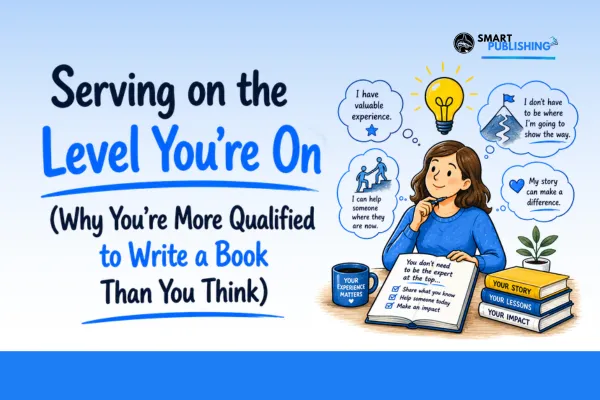
Serving on the Level You’re On (Why You’re More Qualified to Write a Book Than You Think)
Serving on the Level You’re On (Why You’re More Qualified to Write a Book Than You Think)
📘 Smart Publishing Impact Series – Episode 61
One of the most common misconceptions aspiring authors have is the belief that expertise must reach some mythical level before it becomes valuable enough to share.
People assume they need:
More credentials
More years of experience
More recognition
More certainty
Before they are “qualified” to write a book.
As editors and publishers, we encounter this constantly. In fact, one of the most revealing aspects of working closely with authors is discovering that imposter syndrome does not disappear as someone becomes more accomplished. If anything, it often intensifies.
We have worked with first-time entrepreneurs who doubt whether they have enough experience to write a single chapter. We have also worked with globally respected experts—individuals who have spent decades shaping industries—who privately fear that their life’s work is not meaningful enough to deserve publication.
The common denominator is not lack of expertise.
It is perspective.
Most people are simply too close to their own experience to recognize its value.
The Expertise You Dismiss May Be the Exact Thing Someone Else Needs
One of the most important realizations an author can have is this:
You do not need to know everything to help someone with something.
This is where many people become trapped. They compare themselves to the most accomplished figures in their field and conclude that they are not yet “there.” As a result, they postpone sharing what they know until they reach an imagined future version of themselves.
The problem with that mindset is that it ignores the reality of how service works.
You are not called to help everyone.
You are called to help the people you are currently equipped to help.
That distinction matters because there is always someone a few steps behind you who would benefit tremendously from the lessons, mistakes, frameworks, or perspective you have already developed through experience.
In the episode, Jonathan shared a principle that captures this idea well:
“You serve on the level you’re on until you serve on the level you belong.”
That statement reflects a truth many authors need to hear. Service does not begin once you become world-famous, universally recognized, or completely free of doubt. Service begins where you are, with what you know, and with the people you can help today.
Why Imposter Syndrome Appears at the Exact Moment You’re Growing
One of the more fascinating patterns we have observed is that imposter syndrome rarely appears when people are doing things that feel safe or insignificant.
It tends to emerge when someone is approaching growth.
When someone begins:
Writing a book
Launching a business
Speaking publicly
Positioning themselves as an authority
The internal resistance becomes louder.
This is why imposter syndrome can be deceptive. Many people interpret it as evidence they are unqualified, when in reality it is often evidence that they are stepping into something meaningful.
Jonathan used a gaming analogy during the episode that illustrates this particularly well. In most video games, if there are no obstacles, no resistance, and no enemies, you are probably moving in the wrong direction. Resistance tends to appear precisely where progress is located.
The same dynamic frequently applies in creative and entrepreneurial work.
The closer someone gets to meaningful visibility or impact, the more resistance they often feel internally.
The Root of Imposter Syndrome Is Often Self-Focus
One of the most effective ways to overcome imposter syndrome is to understand what fuels it.
At its core, imposter syndrome is often rooted in excessive self-focus.
The internal dialogue becomes centered around:
What people might think
Whether the work is “good enough”
Whether someone else is more qualified
Whether criticism or rejection might occur
The attention remains fixed on the self.
The problem is that self-focus creates paralysis.
Mission focus creates movement.
When an author shifts their attention away from self-evaluation and toward the people they are trying to help, something significant changes. The writing process becomes less about personal validation and more about contribution.
This is one of the reasons mission-driven authors tend to gain momentum more quickly. They are not obsessing over how they appear. They are focused on who they can serve.
And service has a way of simplifying things.
Passion and Service Often Matter More Than Longevity
During the episode, Renee shared a story that illustrates this point clearly.
Near their home is a small, family-owned ice cream shop run by a mother and son. The business is relatively new, has only a handful of rotating flavors, and operates on a much smaller scale than larger franchise competitors nearby. Yet despite having less history, less infrastructure, and fewer resources, the shop consistently outperforms larger, more established brands in customer enthusiasm and community support.
Why?
Because people respond to passion, care, creativity, and authentic service.
The lesson applies directly to authorship.
Many aspiring authors assume they are disqualified because someone else has:
More years of experience
A larger platform
More certifications
A more recognizable name
But expertise alone is not what creates impact.
People are drawn to conviction, clarity, authenticity, and genuine care for the audience being served.
A passionate guide who deeply understands a reader’s struggle is often more impactful than a detached expert with decades of credentials.
Why Your Book Does Not Need to Be Perfect to Be Valuable
Another major obstacle for authors is the belief that the book itself must be flawless before it deserves to exist.
This mindset creates endless hesitation:
Chapters are rewritten repeatedly
Ideas are overcomplicated
Progress slows to a halt
Perfectionism is often disguised as professionalism, but in practice, it frequently becomes avoidance.
A book does not need to contain every possible answer to create meaningful transformation.
It needs to provide clarity, direction, and actionable value.
One of the most important principles discussed in the episode was the idea that authors should focus on simple, applicable steps readers can realistically implement. Jonathan referenced how a single exercise—writing down five things he was grateful for each day—became a turning point during a difficult season of his life.
What made that principle powerful was not its complexity.
It was its accessibility.
Readers are far more likely to experience transformation when they are given practical actions that feel achievable.
This is one of the defining characteristics of a “best helper” book:
It bridges the gap between inspiration and implementation
It removes overwhelm
It creates momentum through action
Your Book Should Create a Next Step
Another important topic discussed in the episode was the role of the call to action within a book.
Many authors misunderstand this concept entirely. They either avoid it altogether or treat it like an aggressive sales pitch inserted awkwardly into the content.
A strong call to action should feel like a natural extension of the reader’s journey.
If the book genuinely helps someone solve a problem, it is reasonable—and often beneficial—to provide a next step for readers who want deeper support.
This might include:
A course
A coaching offer
A speaking inquiry form
A consulting opportunity
Additional resources or tools
The key is alignment.
The next step should feel like a continuation of the transformation the book began. It should not feel disconnected or transactional.
As discussed in the episode, this is why strategic publishing requires what we often call “backwards design.” The book is developed with the end goal in mind—not only for the author, but for the reader as well.
There Is Always a Level You Can Serve On
Perhaps the most important takeaway from this conversation is that service is not reserved for a select group of people who have reached some elite level of accomplishment.
There is always a level you can serve on.
There is always:
Someone who needs your perspective
Someone who would benefit from your experience
Someone who is looking for guidance through a challenge you have already faced
The question is not whether you are qualified enough to help everyone.
The question is whether you are willing to help the people you are already equipped to serve.
Because the truth is, most authors do not become impactful after they feel ready.
They become impactful because they were willing to begin before they felt completely ready.
Final Thoughts
Writing a book is not about proving perfection.
It is about creating contribution.
The people who create meaningful impact are rarely the ones who felt entirely confident before they started. More often, they are the ones who chose to move forward despite uncertainty because they understood that the mission mattered more than the fear.
You do not need to become someone else before your story, your expertise, or your experiences have value.
There is already someone who would benefit from what you know right now.
The only remaining question is whether you are willing to share it.
Until next time—
Keep writing your story, because the world needs your voice.
—Renée

