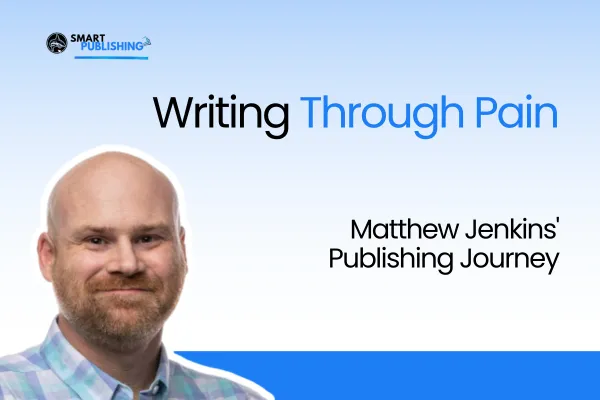
Writing Through Pain: Matthew Jenkins' Publishing Journey
Writing Through Pain: Matthew Jenkins' Publishing Journey
Smart Publishing Impact Series – Episode 70
Many aspiring authors believe they need the perfect circumstances before they begin writing a book.
They imagine a season with fewer responsibilities, more clarity, greater confidence, or complete healing from whatever challenges they have experienced. They assume the book should come after life settles down.
Matthew Jenkins' publishing journey tells a very different story.
His forthcoming book, Beat Up by God: Finding Faith When Life Feels Like It's Falling Apart, certainly explores faith, suffering, and hope. Yet for fellow authors, one of the most valuable lessons is not simply what the book teaches readers. It is what the process of writing the book taught its author.
During Episode 70 of the Smart Publishing Impact Series, Matthew shares how a manuscript that began as a private exercise in healing gradually became a book designed to help others. His experience illustrates several truths that nearly every aspiring author eventually encounters: uncertainty, self-doubt, interruptions, collaboration, and the realization that the book ultimately exists for the reader rather than the writer.
Many Books Begin as Something Else
When people imagine writing a book, they often picture an author intentionally sitting down to create a manuscript from the very beginning.
Matthew's experience followed a different path.
He never intended to write a book.
After enduring an extraordinarily difficult season that included cancer, chronic pain, the loss of his sister, separation from his wife, unemployment, and a mental health crisis, he simply began writing as part of his own healing process. The early pages functioned more like an extended journal than a publishing project. They helped him process experiences that were difficult to understand while he was living through them.
Only gradually did something begin to change.
As the manuscript grew, Matthew realized he was including increasing amounts of Scripture alongside his personal reflections. The writing was becoming more than personal processing. It was becoming a message that could encourage others facing similar struggles.
That realization did not happen during one dramatic moment.
Instead, it developed naturally as chapter after chapter revealed a larger purpose.
For aspiring authors, this is an encouraging reminder that not every book begins with a polished outline or a detailed publishing plan. Some manuscripts reveal themselves through the act of writing.
Your Manuscript Will Probably Change Along the Way
Many first-time authors worry about beginning before they have every detail figured out.
Matthew's journey demonstrates why that concern should not prevent someone from starting.
The project evolved significantly while he was writing. What began as deeply personal reflection gradually transformed into a resource for readers navigating seasons of suffering, doubt, and spiritual discouragement. The audience became clearer. The purpose became stronger. The manuscript itself matured alongside the author.
This happens far more often than many aspiring authors realize.
Early drafts are rarely the final version of the book. As authors continue writing, they frequently gain a better understanding of what they are truly trying to communicate. Stories become more focused. Chapters become more intentional. The overall message becomes more cohesive.
Writing creates clarity.
Many authors discover the book by writing it rather than before writing it.
Every Author Encounters Seasons That Interrupt the Process
One of the most honest moments during the conversation came when Matthew described a period when he stopped writing altogether.
After completing the introduction and four chapters, he was served divorce papers. At that point, he had still been praying for reconciliation in his marriage, and the emotional weight of that experience made continuing the manuscript nearly impossible. Several months passed without any progress on the book.
Aspiring authors often become discouraged when life interrupts their writing schedule.
Work changes.
Health issues arise.
Family responsibilities increase.
Unexpected events consume the time that had been reserved for writing.
Matthew's experience reminds us that temporary pauses do not have to become permanent endings.
Many successful books include chapters that were written months—or even years—apart. What matters most is eventually returning to the work.
A pause is not the same as quitting.
The Most Successful Authors Eventually Shift Their Focus Away From Themselves
One of the strongest themes throughout this episode was something Smart Publishing has observed repeatedly across many publishing projects.
Jonathan and Renee pointed out that nearly every successful author reaches a similar turning point.
At first, many writers think primarily about themselves.
Will people judge me?
Will anyone care?
What if readers criticize my story?
As the manuscript develops, however, successful authors begin asking a different question.
Who needs this book?
Matthew described experiencing exactly that shift. Once he stopped thinking primarily about himself and started thinking about the people the book might help, finishing the manuscript became much easier. The project became less about documenting his own experience and more about serving readers who might one day find hope through his story.
During the conversation, Renee noted that this mindset shift has become one of the most consistent patterns among Smart Publishing authors. Whether writing about leadership, business, faith, or personal growth, authors who successfully complete their books eventually stop viewing the project through the lens of personal vulnerability and begin viewing it through the lens of reader impact.
For aspiring authors, this may be one of the most important lessons of the entire publishing process.
Books become much easier to finish when the author's attention moves from self-consciousness to service.
Professional Publishing Involves More Than Editing
Another valuable discussion centered around Matthew's decision to work with a publisher rather than navigate the process independently.
Initially, he considered self-publishing. As he evaluated his options, however, he recognized that his own cover design ideas lacked the professional quality he wanted for the project. More importantly, he realized the message deserved presentation that matched the importance of its content. A professionally edited manuscript, thoughtful design, and polished production would help the book reach readers more effectively.
This reflects a common realization among first-time authors.
Writing the manuscript requires one set of skills.
Publishing it professionally requires many others.
Editorial development, copyediting, cover design, formatting, typography, launch strategy, distribution, and marketing all contribute to how readers ultimately experience a book.
Authors do not need to become experts in every discipline.
Instead, many discover that collaborating with experienced publishing professionals allows them to focus on the message while specialists manage the technical aspects of publication.
Publishing Is a Partnership
One aspect of the conversation that will resonate with many aspiring authors involved Matthew's description of working through the publishing process.
Rather than feeling overwhelmed by unfamiliar steps, he explained that the structured guidance provided throughout production helped each stage make sense. The process felt manageable because every decision built naturally upon the previous one.
Jonathan expanded on this idea by describing authors as publishing partners rather than clients.
That distinction reflects an important truth.
Publishing works best when both sides contribute their expertise.
The author understands the message.
The publishing team understands how to transform that message into a professional product readers will enjoy.
Neither role replaces the other.
Together, they create something stronger than either could produce independently.
A Book's Impact Often Extends Beyond Its Pages
When Jonathan asked Matthew about his long-term vision for the book, his answer remained remarkably simple.
He hoped God would use it however He saw fit.
Although the response sounded modest, Jonathan connected it to another publishing story from Smart Publishing. He shared how another author's book unexpectedly led to corporate partnerships, leadership training opportunities, and international distribution—opportunities that began simply because someone discovered the book and recognized the value of its message.
This conversation highlights an important principle for aspiring nonfiction authors.
A book rarely represents the end of the journey.
It often becomes the beginning.
Books create introductions.
They establish credibility.
They open conversations.
They build trust.
Many opportunities emerge because a book exists—not necessarily because it becomes a bestseller.
Authors cannot always predict where those opportunities will come from.
They can, however, ensure the book exists for those opportunities to find.
Final Thoughts
Matthew Jenkins' forthcoming book tells a story of faith, suffering, and hope.
His publishing journey tells another story that every aspiring author can learn from.
Books do not require perfect circumstances.
They require persistence.
They require a willingness to continue after interruptions.
They require the humility to collaborate with others.
Most importantly, they require a genuine desire to serve readers.
The manuscript that eventually became Beat Up by God did not begin as a publishing project. It began as one man attempting to make sense of one of the most difficult seasons of his life.
Over time, that private process became a public message.
For aspiring authors, perhaps that is the greatest encouragement of all.
You do not have to know exactly where your manuscript will lead when you write the first page.
You simply have to begin.
The purpose often becomes clearer with every chapter that follows.

